
Post Toasted
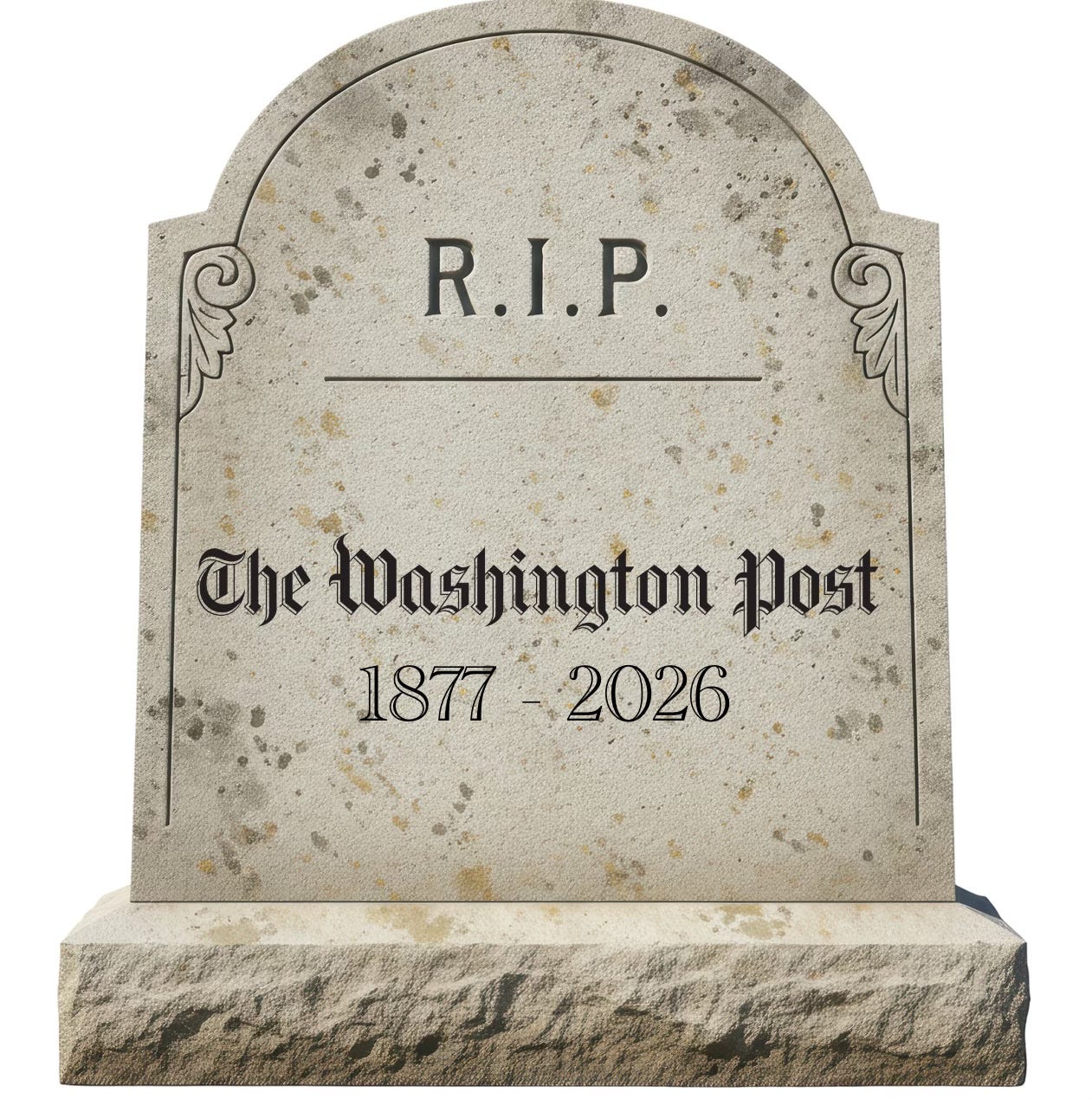
We've seen lots of hometown papers die but the Washington Post's collapse is a straight-up murder

All the way back in the mid-1980s, I found my first-ever “hometown” newspaper: The Washington Post.
I wasn’t in D.C. yet — I was actually three hours south on Interstate 81 in Lexington, Va., studying print journalism at Washington and Lee University. Each morning at the campus bookstore, three daily papers were for sale: the Post, the New York Times, and the Washington Times. Both Times were not for me, because I wasn’t that interested in New York and I had no patience for the cult of Rev. Sun Myung Moon.
Plus, the Post had three full pages of comic strips. Comics were one of the ways I taught myself to read, slowly sounding out the words from the strips in newspapers at my grandparents’ house when I was four. Hell, the funny pages are probably the thing I miss most today.
Those newspapers back home in Kentucky, however, never felt like a “hometown” paper when I was a kid. Whether it was the Paducah Sun or Hopkinsville’s Kentucky New Era, they always arrived on a one-day delay so they weren’t sources of breaking news. They were enough to give me the news bug, along with watching Lou Grant on TV, but I had longed for something bigger.
The Post back then was a massive product, thick with copy even on Monday, the least newsy day of the week. And as I started taking journalism classes and editing the school newspaper, heading to D.C. and working for the Post was my ultimate goal. The Post taught me about the city, about Virginia, about the rough-and-tumble world of politics. Where else would I want to end up?
Obviously, life didn’t follow that course for me. By my senior year I was in an existential crisis about whether I really wanted to be a journalist. I still headed to D.C. but my first job, covering tax and securities issues on Capitol Hill, was such a nightmare I left journalism for almost a decade.
But while I temporarily abandoned journalism, I didn’t abandon the Post. I’ve never lost my voracious appetite for news and the Post never stopped feeding it. I had my rituals with the daily paper, primarily starting with the funnies because a lifetime habit is hard to kill. When the Saturday edition arrived with the Sunday supplement encased in transparent yellow plastic, woe be to anyone in the house who opened that package before Sunday.
There are rules, you know.
It wasn’t until the aughts that I began transitioning from paper to pixels with the Post, not because I found print lacking — I was still publishing my print magazine at the time — but because the writing was on the wall. Change is the great constant and it’s unhealthy to reflexively oppose it.
Like many journalists and readers, the purchase of the Post by Jeff Bezos gave me serious pause. I knew that the days of somewhat benevolent family benefactors — the Grahams, the Sulzbergers, the Binghams — were gone and never coming back. I hoped Bezos would be an owner who saw the value in a well-funded (yet profitable) newspaper. For the first few years and the “Democracy Dies in Darkness” era, that seemed attainable.
But a scorpion has to sting because it’s in its nature. Here we are with a once-great paper at death’s door, reduced to carrying water for the hyper-specific business interests of its owner. It was obvious this was coming for years now. Bringing in a British Fleet Street purveyor as publisher signaled pretty clearly that Bezos was collecting nails for the coffin.
I stuck through as long as I could. I did cancel my subscription after Bezos spiked the Kamala Harris endorsement editorial but, to my chagrin, I came back a few short months later because it’s hard to be without even mediocre local news coverage. Then came the bloodbath of the editorial page and other sections. Friends and colleagues of mine who still worked there were cut loose or walked out. Writers whose work I’d had admired for years were suddenly in the wind.
With that, I had to say my final goodbye to a newspaper that had meant so much to me over the years — even through the times when it pissed me off with its coverage of HIV/AIDS, the gay community, or LGBTQ media. No daily newspaper is perfect. They are too big and contain too many voices for that. But before Bezos, the Post at least appeared to try.
Everyone here, whether in D.C., Maryland, or Virginia, loses because Bezos decided to strangle our hometown paper. Like so many other cities across the nation, one of our most vital organs is failing, in this case on purpose. Barring some miracle, it seems unlikely we’ll have resurrection or successor (if you think the Washington Times is an option there are plenty of proverbial bridges out there for you to purchase).
A lifetime habit may be hard to kill but Bezos proved to be a skilled assassin.